Returning to the Roots of Hankyu: Seen in 'Let's Go Home by Hankyu'

Please read this not as a researcher of diversification strategies, but as a casual essay by an individual.
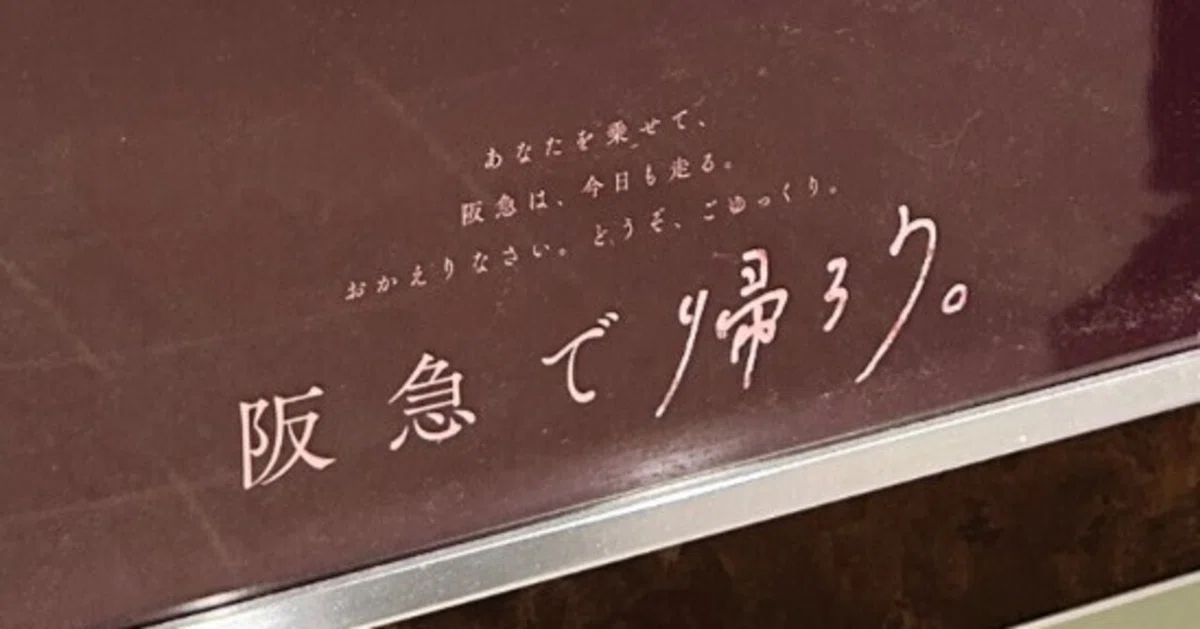
An advertisement I saw when I rode the Hankyu train the other day.
"Let's go home by Hankyu"(1)
At that moment, it was instinctively translated in my brain as:
"Stay along the Hankyu line"
It's amazing, I thought, a return to the roots.
To "go home by train" means that your home is located along the Hankyu line.
It is a bit different from trends like the return to city centers, the popularity of high-rise condominiums, or the proximity of work and home due to remote work.
To me, this copy seemed to contain the message:
"We want you to keep living along the Hankyu line."
Hankyu Corporation is not just a railway company.
They combine department stores and hotels at stations to enhance the appeal of the line. They develop residential areas and maintain life infrastructure such as electricity and water. And they lower the hurdles for purchase through things like housing loans.
They increase railway users while nurturing the line itself.
I believe one of the major reasons why private railways have been able to continue their business for over 100 years is this management of the railway line. And at the origin of that is Hankyu.
In a pamphlet from 1907, shortly after the company's founding, the following text is published.
Oh, you unfortunate citizens of Osaka, who live in a city of dark, smoky skies, as the beautiful city of water has vanished like a dream of the past! Those of you who pay attention to the sanitary conditions of Osaka citizens, where the death rate is over 11 for every 10 births, must feel a shuddering sense of the helplessness of urban life. At the same time, your longing for a pleasant suburban life rich in pastoral tastes must be intense.
Reading it now,
I almost want to say, "Are you looking down on Osaka?"
However, that was also an era when cities faced serious issues such as overcrowding, deteriorating sanitary conditions, and public safety problems.
The idea of creating new towns in the suburbs as a solution was an answer to challenges shared not only by Osaka but by major cities around the world.
What had a major influence on this era was Ebenezer Howard's "Garden City Movement."
Howard sought to move away from urban overcrowding and create self-sufficient cities that included not only places to live but also places to work.
What is interesting here is that Hankyu's garden cities have no "work."
The places to live are in the suburbs.
However, the places to work remain in the heart of Osaka.
So people head to Umeda.
And every day, they ride the Hankyu train.
While Howard aimed for cities that were self-contained outside the city, Hankyu created a system that functions by continuing to connect the city and the suburbs. If everything were completed within the garden city, the railway company's business would not be viable.
In that sense, it could be said that while Hankyu incorporated Howard's philosophy, they reshaped it into a form that was extremely realistic as a railway company.
The Hankyu line built over more than 100 years.
The pride and attachment to living along the line, a certain brand value.
As society as a whole seems to be losing confidence little by little due to population decline and shrinking consumption, I felt that the copy "Let's go home by Hankyu train" was quietly speaking to that origin.
It is not just for the users.
Perhaps it is also a message to the employees,
"Who was Hankyu?"
reminding them of that.
Of course, it is not as sharp as the pamphlet from the time of founding.
But in the modern day, there is enough cultural accumulation that it conveys the message without needing to be that sharp.
Thinking about it that way, I think the philosophy that Hankyu has nurtured for over 100 years remains deep within this gentle copy.
Nevertheless, on the other hand, they are also naturally developing a collaboration with Curious George.
Returning to the roots and shrewd business.
The fact that they are running these two things in parallel as if nothing is the matter is also very Hankyu-like and interesting.
(1) Let's go home by Hankyu
[References]
・Keihanshin Kyuko Electric Railway Co., Ltd. (1959) "Fifty-Year History of Keihanshin Kyuko Electric Railway"
・Ebenezer Howard (1902) Translator: Hiroshi Yamagata (2016)
"[New Translation] Garden Cities of To-Morrow" Kajima Institute Publishing